


Argentina Citizenship by Investment: Cost, Timeline, Documents and Risks


Key Takeaways
- Main applicants choose between a non-refundable Treasury contribution of US$350,000 or a dedicated government bond of US$800,000.
- Family members add US$100,000 per spouse, US$100,000 per unmarried adult child aged 18 to 25 with no children, and US$25,000 per child under 18.
- Applications are expected to open in Q4 2026, but no exact date has been published.
- Government fees, due diligence fees and the official document checklist have not been published yet.
- Check your home country's dual-citizenship rules before committing.
This article reflects official announcements and industry sources available through October 26, 2026. Applications are not open yet, and details may change once the final rules are published. We will keep this page updated.
What Has Argentina Actually Announced?

On October 2, 2026, Argentina's Economy Minister announced the country's citizenship by investment program at an event in Paris, setting out two investment routes and a Q4 2026 launch window. The legal basis is Decree 524/2025, signed in July 2025, and the program will be run by a newly created body, the Agency for Citizenship by Investment Programs (APCI).
In short, the headline numbers are settled, but the practical details are not. The investment amounts and family contributions are confirmed. The opening date, government fees, official document list and authorized-agent criteria are still pending.
How Much Does Argentina Citizenship by Investment Cost?

Two Routes for the Main Applicant
The first route is a non-refundable contribution of US$350,000 to the National Treasury.
The second route is the purchase of a US$800,000 government bond created for the program. Media reports describe it as a seven-year, zero-interest bond, but the October announcement did not confirm those terms. Until the official conditions are published, the two routes cannot be compared precisely, and a higher amount is not automatically better or worse once liquidity and opportunity cost are considered.
Industry commentators expect most applicants to choose the US$350,000 contribution route.
Costs for Family Members
A spouse and children can join the application by proving the family relationship and making an additional Treasury contribution.
- Spouse: US$100,000
- Unmarried child aged 18 to 25 with no children: US$100,000
- Child under 18: US$25,000 each
The bond is understood to cover only the main applicant, so family contributions are the same under either route. How a child's age is assessed for the upper age limit has not been explained yet, which matters for families with a child close to 25.
Example: A Family of Four

For a main applicant, a spouse and two children under 18:
- Contribution route: US$500,000 in total
- Bond route: US$950,000 in total (US$800,000 bond plus US$150,000 in family contributions)
What Other Costs Should You Expect?
Application fees, due diligence fees and processing charges have not been published, so a true all-in cost cannot be calculated yet.
Programs of this type usually involve costs beyond the qualifying investment, such as government processing and due diligence fees, document translation, notarization and apostilles, and professional adviser fees. Argentina's exact figures are unconfirmed. Any provider quoting a final total today is estimating.
When Will Applications Open?

The government has said it will accept applications in Q4 2026 (October to December). No specific date has been announced, and as of mid-October the Economy Ministry's information still described a fourth-quarter opening without an application form.
The expected sequence is:
1. Program announced (October 2, 2026, completed)
2. Detailed regulations published
3. Authorized-agent criteria released
4. Applications open (expected Q4 2026)
Under the legal framework, the National Directorate of Migration has 30 business days to decide once it receives the APCI's report. The October announcement did not repeat this deadline, so how it works in practice remains to be seen.
How Does the Due Diligence Process Work?
The APCI leads each assessment, working with the State Intelligence Secretariat, the Financial Information Unit, the Ministry of Security and the Ministry of the Interior. It then sends a recommendation to the National Directorate of Migration, which approves or rejects each application.
Checks cover identity, the lawful origin and traceability of funds, assets and finances, jurisdictional risk, criminal and reputational records, and immigration history. All payments must go through the formal financial system and meet anti-money-laundering standards. For most applicants, source-of-funds documentation is likely to be the hardest and slowest part.
Which Documents Will You Need?
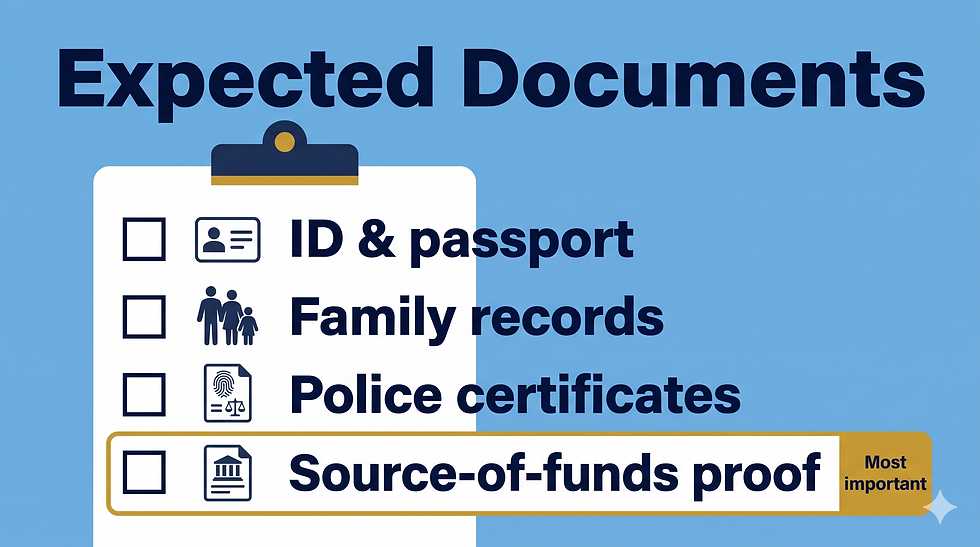
No official checklist has been published. Based on typical citizenship by investment programs, applicants should expect to prepare:
- Passport and identity documents (KYC)
- Birth and marriage certificates and other family records
- Police certificates from every country of long-term residence
- Source-of-funds evidence such as bank statements, income records and asset-sale documents
- Health-related documentation (details not confirmed)
- Professional background information
- Certified translations, notarization and apostilles where required
This list is an expectation, not an official requirement. What you can do now is organize your source-of-funds trail. If your capital has moved through several accounts or entities, document each step from the day it was earned to the day it reaches the government account.
Key Features of the Argentina Program
No Prior Residence Requirement
Argentine naturalization normally requires two years of legal residence. The 2025 decree created an investment-based path that does not depend on how long the applicant has lived in the country.
Dual Citizenship
Argentina recognizes dual nationality, and the program is understood not to require renouncing your existing citizenship. Whether your own country allows it is a separate question (see below).
Regional Residence Rights
Argentine citizens are reported to benefit from the MERCOSUR residence agreement, which can make it easier to apply for residence in countries such as Brazil and Uruguay. Procedures and conditions differ by country, so verify them before relying on this.
Tax Treatment
Industry reports say recent legislation treats investment-route citizens as tax residents only after 12 months of actual presence in Argentina. This was described as of April 2026, so confirm that it is in force and how it applies to you. Tax outcomes depend on your nationality and where you live, so speak to a qualified tax adviser.
Check Your Home Country's Dual-Citizenship Rules First

Argentina allowing dual nationality does not mean your country does. Some countries restrict or remove citizenship when a national voluntarily acquires another. For example, South Korea's Nationality Act generally provides that a citizen who voluntarily acquires foreign nationality loses Korean nationality, subject to exceptions. Other countries have their own rules on dual citizenship, reporting obligations and tax.
Before you commit capital, confirm how your country treats a second citizenship, using official sources or a qualified lawyer. BBK Passport is not a law firm and does not provide legal or tax advice.
Risks and Cautions
- The program has not opened. Application forms, fees and authorized-agent criteria are not yet published, so be careful with anyone asking for deposits or fees before that.
- Verify any provider's registration, contract terms and refund conditions before paying anything.
- The program rests on a presidential decree, and legal-stability questions have been reported. Rules could change before or after launch.
- The bond terms are unconfirmed, and holding government debt involves sovereign credit risk.
Frequently Asked Questions
How much does Argentina citizenship by investment cost?
Main applicants choose between a non-refundable Treasury contribution of US$350,000 or a US$800,000 government bond. Fees beyond the investment have not been published.
How much does it cost for a family?
A spouse adds US$100,000, an unmarried child aged 18 to 25 with no children adds US$100,000, and a child under 18 adds US$25,000. A family of four with two young children pays US$500,000 on the contribution route.
When can I apply?
The government plans to open applications in Q4 2026, but no exact date has been given. Detailed regulations and authorized-agent criteria are expected first.
What documents are required?
No official list exists yet. Expect identity documents, family records, police certificates and, most importantly, proof of the lawful source of your funds.
Do I have to live in Argentina?
The program is designed so that citizenship can be obtained without a prior residence period. Any visit or biometric requirements have not been confirmed.
Does Argentina allow dual citizenship?
Yes, Argentina recognizes dual nationality. Whether your country of origin does is a separate question you should verify.
Is the bond refundable?
Reports describe a seven-year, zero-interest bond, but official terms have not been confirmed. Wait for the published conditions before comparing it with the contribution route.
Bottom Line

The main applicant's investment is US$350,000 (contribution) or US$800,000 (bond), with US$25,000 to US$100,000 added per family member. Applications are expected in Q4 2026, but the date, fees and document list are still unpublished.
Right now is a time to prepare, not to rush. Organize your source-of-funds records, check your home country's rules, and compare options once the final regulations are out. We will update this article as soon as new details are released.
Disclaimer: This article is for general information only and is not legal, tax or investment advice. Information is based on public sources available through October 26, 2026 and may change when Argentina publishes its final regulations.
Contact BBK Passport
BBK Passport is a Hong Kong-based company that markets citizenship by investment programs to international clients. If you would like to receive updates on Argentina or discuss which program may suit your situation, get in touch.
Email: bbkpassport911@gmail.com
Phone: +852 5419 2132 (English Only)
Direct Inquiry: Click on one of the banners below for your preferred messaging app.


Comments